I started this blog five years ago yesterday [What?!? Where does the time go? We’ve had like four apocalypses since then. Where have I found the time?] and in those five years I have only written two posts on it that I have felt met criteria for me to tag them #religion. I think it is “interesting” that on a blog whose subtitle is “hierophanies for the secularly inclined” I have made shockingly little mention of most of these hierophanies. This is mostly because I know that the vast majority of my friends [and my imagined readers who are like my friends and care about the other things that I might write about] think that religion is stupid and that my adherence to it is quaint at best and potentially dangerous at worse. I have written before that it is important not to shit on your audience, and I think that this is part of why I have shied away from talking about religion on my blog that I have intended to be a reflection of my unique perspective in the world which is absolutely [but not exclusively] a religious perspective.
If you go to my church, some of this is recycled from sermons you may have heard me give in the past, but there is new stuff too. And if you’re like, “ugh church,” this one might not be for you, but if you’re a properly open-minded liberal you’ll keep reading anyway.

I prefer to identify not just as religious, but deeply religious. This is partly because it is actually true [I am a lay minister, for chrissakes] and partly because I know that it makes the hairs stand up on the backs of the necks of interlocutors out in the real world whose radar about who is and is not a “crazy” person feels super scrambled when I say it. I am trying to fuck with people when I say this, but to fuck with them on two levels and entirely for their own good.
First our society’s assumptions and received wisdom about what the word “religious” means are unexaminedly incorrect. If you are a person in US [and probably most of the “western” world] “religious” is a byword for Christian and more specifically for the sort of evangelical or expressly devout Christian that seems wholly alien [and scary] to the secular world while being completely familiar and comforting to large swaths of the rural US. I am not a Christian. Even a little bit. I let people who are Christian assume, without contradiction, that I am like them [because I am, I am religious] so I get to really talk to them from a place of shared identity. They tend to be relieved, and if they are an educated person out passing as secular in the world, they tend to unburden themselves to me about the struggles of being a person of faith in our modern world. This is a great joy and blessing. When secular people learn that I’m not Christian they are slightly confused, but they adapt. They assume that I must be like a Jew or a Buddhist and this steadies them because those religions seem less “crazy” [they are not less “crazy”]. But I am not those things either so then I get this like super-minority cache, like it’s my heritage and should be taken more seriously. I must have a “sexy” religion that they now get to collect so they can tell their friends about me at a dinner party. This often makes me wish I was a Zoroastrian or Jain or something so obscure that I’m too much of a curiosity to them to be perceived as threatening. The weirder someone’s identity the more sacred a secular person will treat it. Somehow the extreme inability to understand that perspective legitimizes it, whereas garden variety deluded religious people are too common to be given any respect.
But my religion is not some “strange” or foreign religion that I have to practice because I’m like the last one alive and my weird culture will be lost to all history. I’m just a garden variety Unitarian Universalist. A sort of boring [arguably] white people religion that appears to be kind of secular humanism with hot-dish that makes people who are secular think, “why bother? Why not just play pickle ball?” And makes Christian [or other types of “real” religious] people think, “oh, is this some New Age bullshit? That doesn’t seem real.” Upon learning what my religion is everyone concludes that I can’t be properly religious which is a problem with their definition of religion, not a problem with my religious identity. Just like it’s hard to talk about your gender identity with someone who insists that there are only two genders if you don’t have one of those two genders, it is difficult to discuss my religion with people if they have too narrow an understanding of what “religion” is. I have a religion, I am religious. So, when I tell people that I am religious I am trying to get them to understand that their definition is problematic whether they are religious themselves or whether they think religion is insane. People don’t like it, I get that. I’m a pain in the ass.
Second, IF [and this is a big if] I am able to get someone to concede that I am a religious person after all, even though the religion that I have doesn’t fit into their mental construct of what a religion is, I am then asking them to grapple with the idea that the box is not only bigger than they thought but that it is possible to be in that bigger box and that I – a person they thought was not “crazy” but now they are less sure in their conviction – exist in that larger box for some reason. What is the reason? Why would an apparently rational person who understands that religion is already a third rail in our society choose to identify, loudly and proudly, as deeply religious? Why not keep that weird shit to yourself? And that, cats and kittens, is the million dollar question.
Because I think that religion has immense and essential value to society.
Now, if you’re a person who already identifies as deeply religious [you’re probably not reading this blog anyway but] you are not surprised that religion has immense value because you have built your life in such a way as to center that value in it. After all, you identify as deeply religious. That identity carries weight to it. You spend time going to church or synagogue or praying multiple times a day or participating in religious ceremonies and rituals. You divert monetary resources to the infrastructure that supports your religion. Your friends and colleagues and family mostly also participate in this religion. It is one of the most central parts of your life. So the idea that it has value is self-evident to the point of being irrelevant or absurd. Of course it has value, why would you spend all that time doing something if you thought it didn’t have value? No one would.
But if you’re not religious you have made a decision that religion doesn’t have value to society [you have, presumably, built your life around something meaningful, right?]. In fact, a lot of people who are not religious have decided that religion has negative value to society, that it is actively a bad thing and that it deteriorates and erodes important parts of society. I get why people think this, but I disagree with them. And making other people hold the tension about the contradictions of our beliefs is the part of identifying as deeply religious that I think has the greatest ROI. It’s a very nuanced tension.
Usually, the non-religious [nones] think they have a really good reason for eschewing religion. And some of their reasons are not bad, especially if their objections are about the abuse of certain religious institutions. Abuse is against my religion. I think abusing people, and certainly systemic abuse of people, is very bad. But I don’t find myself convinced that this is a religious problem, per se. After all have you seen ANY institution? They are all subject to abuses of power. Yes the Catholic Church has covered up the systemic sexual abuse of children for a shockingly long time. That is bad. But the Catholic Church isn’t all religion. That sort of thinking is literally a logical fallacy. The medical establishment has been systematically sterilizing and experimenting on disabled people and minorities and the poor for also a shockingly long time. People can understand that the reasons for that are related to scientific racism and eugenics and amorality but they don’t hold all sciences and scientists as net evil for society because of it. It is possible to say that the Catholic Church is bad or evil [maybe it is, idk] but I don’t know that it makes sense to say all religion is bad because one religion’s clergy has been powerful enough to hide systemic abuse. Holding that view is at best intellectually lazy and at worse intentionally disingenuous. The fact that bad things have been carried out in the name of a religion [or many religions] is not a wise point to contest [and I won’t contest it], but religion is modernity’s scapegoat for the evils of humans: we are all plenty capable of being evil without religion so the reason we do bad stuff can’t be solely due to religion and so a purge of religion and religiosity is not going to solve that problem for us.
Most of the time when I have this conversation with people I think they understand that religion isn’t actually all bad [even if they personally think evangelical Christians are destroying the fabric of civil society], but they can’t really understand why it isn’t still “bad enough” that we should get rid of it or let it go away all together. Because of the definitions problem [the conflation of the term “religion” with wacko Christianity] and the lack of other representations of religion besides the common definition, most people see the creeping attrition of religion as net neutral or good. They think that a society that is less religious is better, more rational, more just and is overall progressing toward a better outcome than a society that has religion in it. This is because people view religion as being coercive and oppressive even when they are not outright conflating it with fundamentalist Christianity or Islam. We assume that a religion that tells you what you must believe and has a bunch of [mostly] white guys in silly robes pulling the strings is wrong. I would contest that any system that tells you want you must believe and has silly [white] guys in charge of it is problematic and should be examined. I find neoliberal capitalism to be infinitely more coercive, oppressive and powerful in society than any religion because of the scale of its practice. The god that is the market and the priests who run our economy have long ago outstripped any mainstream religion in centralizing power through blind faith and coercion [and environmental destruction]. And most of the same people who would say they find religion bad are only barely able to see what is wrong with the theory underneath economics that drives our entire lives. If secularism was better for society than religion I feel like it should have protected us from the oligarchs – that’s all I’m saying.
But religion being essentially not actively bad or actively not that bad is [not even based on sentence construction alone] not the same as religion being good. But I think that religion as an abstract noun is in the same category of things as “family” and “language” and “education,” which is to say things that I think are mostly actively good. I can see why this is something that is maybe too much of a leap for people. But the leap isn’t as vast once we have a better definition of religion. I find most orthodox [which to say dictionary] definitions of religion to be lacking. They focus on belief a lot, or supernatural things like as my son says, “sky wizards”. The definition that I favor borrows heavily from Alain de Botton’s Religion for Atheists [a book everyone should read] and the OED’s definition of language, but it’s my own, and – alas – not particularly portable [feel free to suggest updates in the comments]. People won’t immediately like it because it’s very hard to override the definition that your brain wants you to use with this new one. And, it’s clunky, full of SAT words and therefore hard to explain to children [a critical requirement for something to be real]. But, this is the only definition I have found that can include things like Evangelical Christianity, Buddhism, polytheisms [ancient and current], and varied indigenous religious systems without collapsing into some sort of hierarchy of cultural evolution [which would be, like, racist and supremacist]. It’s a syncretic definition of religion that supports the idea that religion is principally something people do in community more so than it is something people believe.
Religion: a system of social cohesion used by a community or group that is characterized by acculturated practices or behaviors that reify ideals, beliefs, and values ; a principle social technology.
I find it likely that people will read this and think, “I don’t know how this helps with this discussion,” which is fair. My principal thesis is that religion is a good and necessary thing, which on its face seems like a ludicrous thing to say in the modern world. That seems like magical thinking because tons of people don’t have a religion and are still good people. It appears as though we don’t need religion anymore, that it is vestigial, and that people who insist on it are retrograde and simple-minded. But, the reason I think religion is good and necessary is because I don’t see that the world lacks for good individuals, I see that the world lacks for good social systems. Sure one person can have an ideology that they hold to dearly and it ensures that they are not only good to their fellow humans but that they have a great and enjoyable life [maybe they identify as “spiritual but not religious”?]. But how do you get that little pocket of wisdom and virtue to scale? And the answer to that is religion. Say what you want to about some of the foundations of some religions at scale [I have said some of it above] but you can’t deny that religion spreads. It’s memetic, in the original sense of the word [as coined by Richard Dawkins, my least favorite fundamentalist atheist of all time]. Lots of things are memetic that are not religion, which is clear if you spend any time on the internet. Humans love to get these little nuggets of ideas – memes – and spread them [it is the love language of my generation]. They can go viral. They can overtake people and society and they can remake them both. Ideas are hella powerful.
Religion leverages something essentially human in the same way that language does to spread ideas but, importantly, it reigns that spread in and gives it broader meaning through a series of behaviors and practices, a system of shared value. It contextualizes the creative spread of memes and helps people know how to incorporate them into the wider meaning system. Secularism doesn’t have a way to do that. It strips the value away from ideas and allows them all to mashup together in a near infinite soup of possibility. It gives people a neurologically impossible amount of choices about what is valuable without instilling in them any way to discern meaning and value. This is also something that is very clear if you spend any time on the internet. We live in a time where meaning is collapsing all around us and we are isolated from collective understandings of what is valuable to ourselves as a group. Lots of people write about this, and I read what pretty much all of the say. Sometimes, often, I look out at metamodernity and what I see is the flailing fear of uncertainty about what anything means and how to behave. MAGA faithful think the answer is a return to a regressive culture of homogeneity and the construction of a Christian nationstate that denies the identity politics that they perceive has fractured us and made us fall away from Lord Trump’s plan [or whatever]. And the only other option seems to be – it sort of sounds like channel surfing did in the before times – an ADHD-fueled collective fever dream of decision fatigue that ultimately outsources our ability make value judgments to fashion or authority or habit or the algorithm.
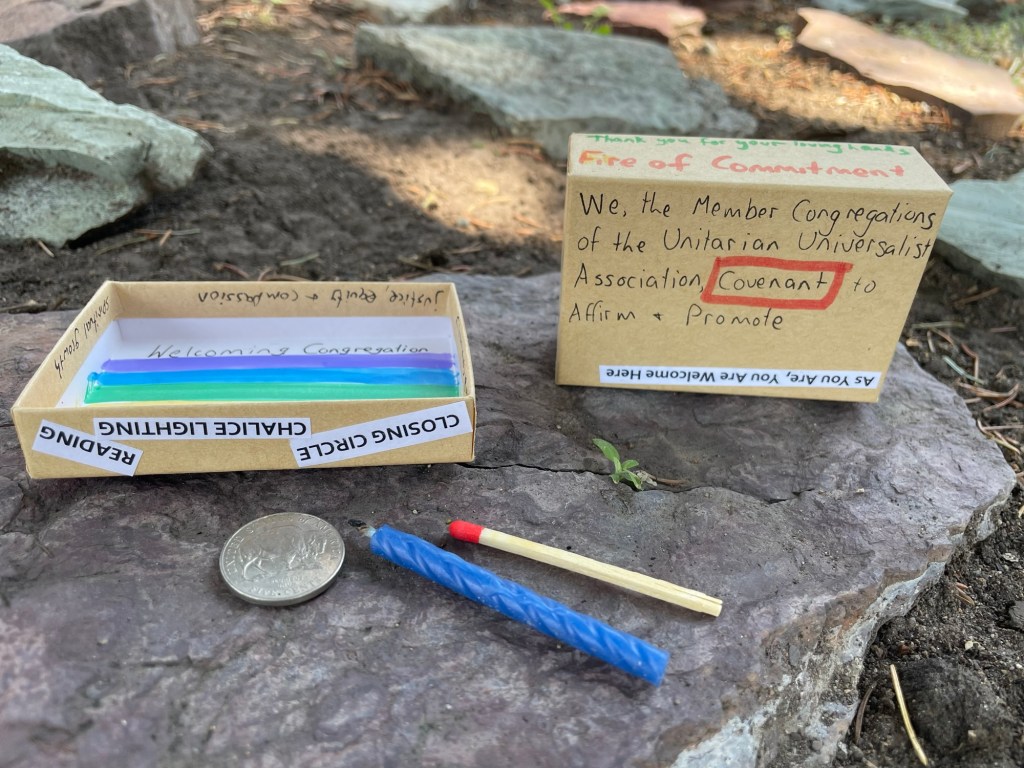
I happen to think that an “older” social technology like religion contains within it an evolutionarily tested method for turning down the volume on that static, though I understand why people might be afraid of it because, like, the Inquisition. But also, I have a good religion. Not just good because it is covenantal instead of creedal [meaning that it rests on a collective promise instead of a statement of faith], but because it can thrive in an information rich and individualistic society since it’s foundational values support pluralism and interdependence, but also justice and equity. It is based on the idea that people need to grow together in community and change their minds. It’s a non-exclusive religion as well, you don’t have to not be a Christian or not be an atheist to be included. I get that this is the part where it sounds very proselytize-y. You don’t have to join my religion, but maybe consider one? There are many on offer and one of them might be right for you. The Dalai Lama says you should keep the religion of your people because its better to stay in your culture than try to join another you don’t understand. Maybe if you were an active member of the religion of your ancestors [from like mid-century Michigan or whatever] then it wouldn’t be full of the assholes who are currently living in it. All I am saying is that not having a religion keeps people isolated from one another in a time where both isolation and the need for collective action is increasing. So in a certain way, yes, I am proselytizing because I don’t want like-minded people to be separated from working together simply because they are outside of this social technology. The other side is winning because they are using the best tool for the job.
Wayyyy back in the early aughts, when I was writing on my first blog, I called it The Religious Left and Other Stories. As an ecstatic agnostic who spent most of my time in a drug-fueled [I think we’d call it a polycule now?], writing about religion was probably even more random then. It was the fat times, everything was good and social media and smartphones were not even a thing yet. We had barely politicized global warming and, sure W was president but doesn’t he look so much more human now? A lot of the writing I did on that first blog was not good, and a lot of the people who read it were even more antagonistic to religion than the polite, middle-aged people I currently associate with. But the topic has long been important to me because, as a teenager raised by atheists in the Bible Belt, being surrounded by people who had something I didn’t have – religious community – was both intriguing and indicative of a gap in my own life. It allowed me to understand that the secular approach to life is not automatically better just because it doesn’t have obvious clerics or priests. People are not more free or more happy and fulfilled simply because no one is telling them what to do, they are just more anxious and less sure of the choices that they are making [and still using mental shortcuts to move through the world]. So if being in a hierarchical, oppressive culture isn’t for you, consider giving a liberal religion a try. We exist and we want to welcome you.
And probably, now that this blog is 5 years old, I am finally going to commit to writing more about religion because it’s important to me. Strap in [and like and follow] for some New Time Religion.
 The Oracle of Z